


If you want a few printed sudoku pages for a child to solve in pencil, the usual snags are a sign-up wall, pop-up ads, or an answer key bound into the same file in a way that is hard to leave out. On November 19, 2026, in desktop Chrome, we opened SudokuSheet without creating an account, generated and downloaded three PDFs with different settings, then checked the page count, paper size, and digits with pdfinfo and pdftotext.
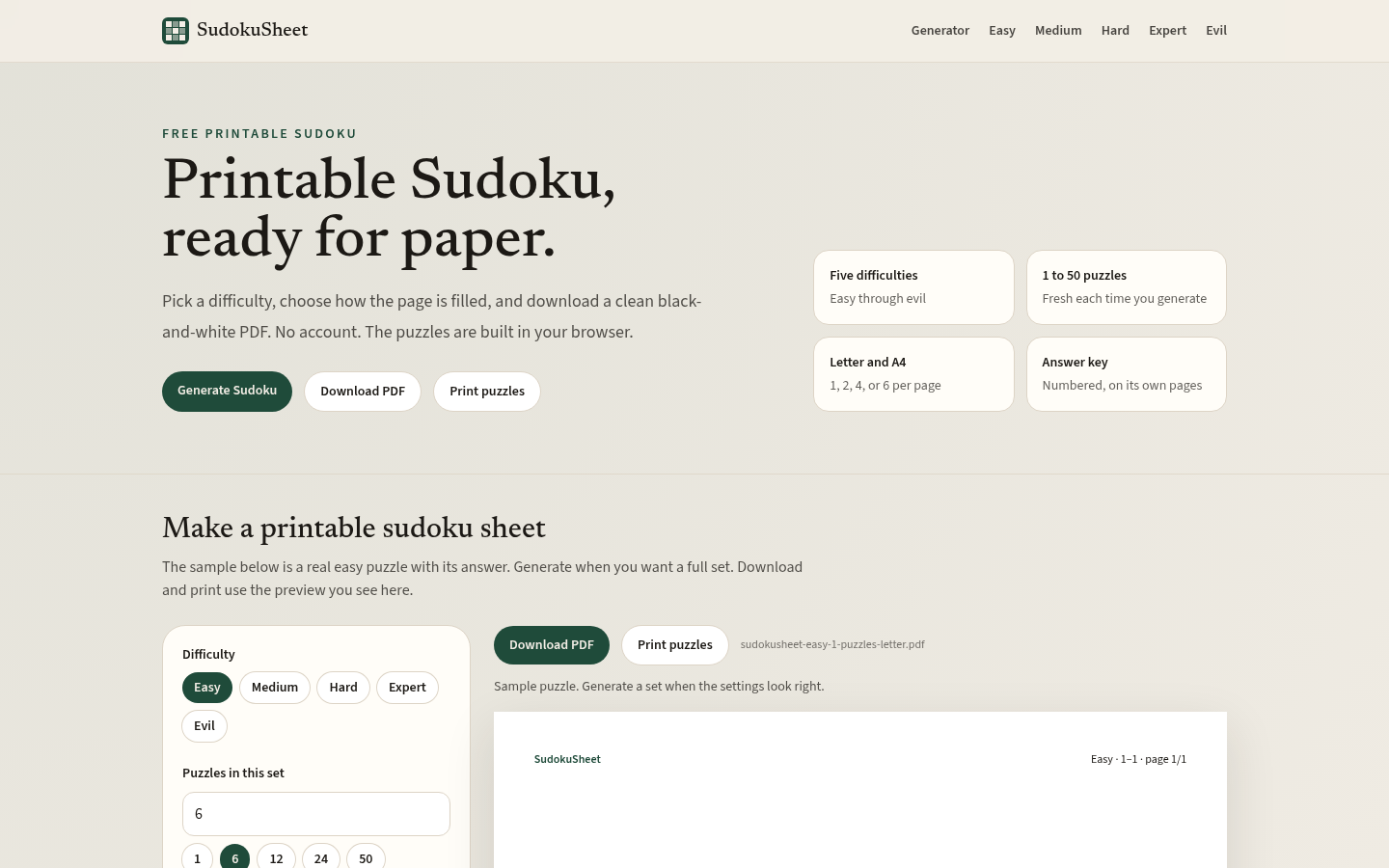
The homepage title is “Free Printable Sudoku Puzzles | SudokuSheet,” and the interface is in English. We did not see a cookie banner, a registration wall, or a pop-up ad when the page opened. The footer said 1.0.0. The About page describes this as an independent site; it does not name a company, and there is no member login. We did not find a verifiable public license, so this article does not present it as an open-source project. One other detail: opening the site over HTTP at http://sudokusheet.com/ returned 500. This test used HTTPS.
Who it is for, and what the page offers
It is a good fit for parents, teachers, or anyone who has already decided to work on paper and wants to lay out a set in the browser, then export a PDF. It is not a game for filling in digits on screen. If the goal is to get practice off a screen and onto paper, that is in the same family-use neighborhood as StudyOnTV, which we have also written about — but StudyOnTV manages TV watch time, not printable worksheets.
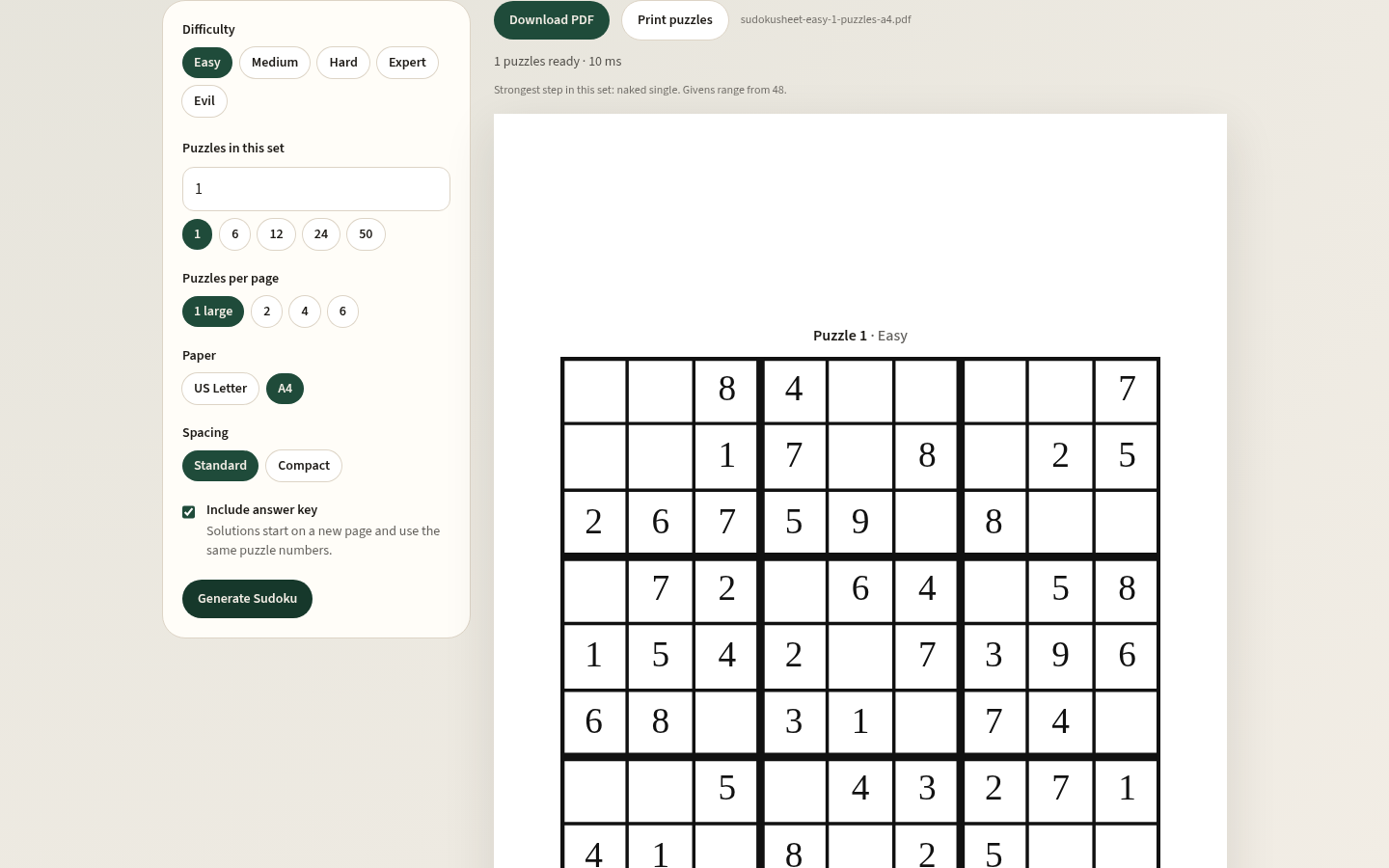
The generator sits in the lower half of the homepage. The defaults were Easy, a set of 6 puzzles, 2 per page, US Letter, Standard spacing, and “Include answer key” checked. The controls we actually saw were:
| Item | Options we saw on the homepage on November 19, 2026 |
|---|---|
| Difficulty | Easy, Medium, Hard, Expert, Evil — five levels |
| Puzzles in a set | A number field, plus buttons for 1 / 6 / 12 / 24 / 50; the copy says you can go up to 50 puzzles |
| Puzzles per page | 1 large, 2, 4, 6 |
| Paper | US Letter, A4 |
| Spacing | Standard, Compact |
| Answers | “Include answer key,” with a note that answers start on a new page and use the same numbering as the puzzles |
| Actions | Generate Sudoku, Download PDF, Print puzzles |
When the page first opened, it showed a fixed Easy sample named sudokusheet-easy-1-puzzles-letter.pdf, labeled “Sample puzzle.” To get a set of your own, you have to click Generate again. We did not click Print puzzles, and we did not hook up a printer.
What the three PDFs actually contained
The test was on November 19, 2026, in desktop Chrome, without signing in. All three files used A4 and Standard spacing. We clicked Generate, then Download PDF. The browser started the download directly, and the suggested filename matched the name in the preview.
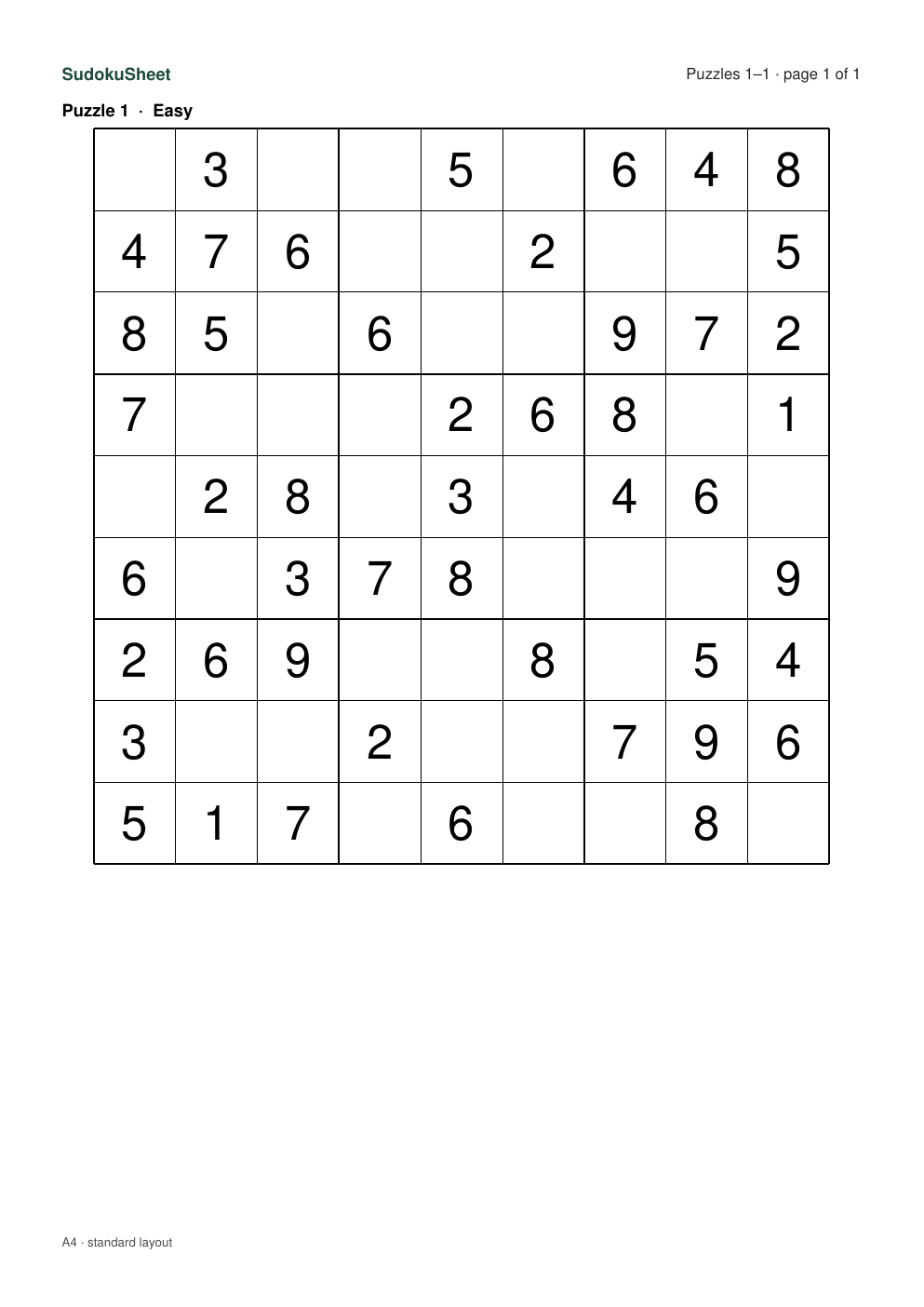
First file: Easy, 1 puzzle, 1 puzzle per page, answer key on. Generation took about 0.9 seconds. We got sudokusheet-easy-1-puzzles-a4.pdf, 5,093 bytes, 2 pages, page size 595.28 × 841.89 pts, which is A4. Page 1 had only the puzzle. The header read SudokuSheet, Puzzles 1–1 · page 1 of 1, and Puzzle 1 · Easy. Page 2 was Answer key · page 1 of 1, titled Answer 1. Both footers said “A4 · standard layout.” The grid was black-and-white lines and digits; it looked like a vector grid, not a smeared photograph, and there was no large watermark. The metadata listed Producer as SudokuSheet 1.0.0, with a creation time of 2026-11-19 08:29:07 (Asia/Shanghai).
We compared the given digits on page 1 with the complete answer on page 2. The answer had 9 rows of 9 digits; each row, column, and 3×3 box contained 1 through 9 exactly once, so it was a valid sudoku solution. The givens on the puzzle matched the same cells in the answer. The preview had also said this puzzle had 47 givens, with the strongest step being a naked single. In row 2, for example, we could read 4, 7, 6, 2, and 5, and the answer row was 4 7 6 8 9 2 3 1 5, which matches, with no repeated visible digits in that row.
Second file: Evil, 6 puzzles, 6 per page, answer key on. Generation took about 1 second. We got sudokusheet-evil-6-puzzles-a4.pdf, 18,053 bytes, also 2 A4 pages. Page 1 held Puzzle 1 through Puzzle 6, all labeled Evil, arranged in a six-up grid. Page 2 held Answer 1 through Answer 6, not mixed onto the puzzle page. We extracted the six answers as text; all six passed a check that each row, column, and box contained 1–9 with no repeats. The puzzle page was denser, with fewer givens. We did not compare every empty Evil cell with its answer, and we did not solve the set by hand.
Third file: Easy again, 1 puzzle, 1 per page, A4, but with “Include answer key” unchecked. We got a PDF with the same suggested name (saved separately on disk), 2,596 bytes, and only 1 puzzle page, with no answer page. So the answers can stay in the file on a separate page, or you can drop them entirely and print only the puzzles. One small catch: even with the answer key turned off, the PDF Subject still said “Printable Sudoku puzzles with a separate answer key.” Do not rely on the file properties alone to tell whether answers are inside; opening the page count is more direct.
If you want to inspect a PDF after export — how many pages it has, and whether anything extra is hiding in the file — we have written about AnyRedact. The job is different, but both approaches look at the file itself, not only at the label on the download button.
What we saw on the network while generating
The site itself says the puzzles are generated in the browser, that the digits are not uploaded to a server to be stored, and that no account is required. That is the site’s statement, not an audit conclusion.
While we generated and downloaded these three files, we did not see a POST that sent a puzzle grid or a PDF to a third-party host. The download was received directly in the browser; it did not first jump to a PDF URL. The third-party requests we saw were mainly https://www.pvuv.ai/f.js and several POST https://in.pvuv.ai/in calls (roughly 276 to 604 bytes). There were also Cloudflare cdn-cgi/rum and static.cloudflareinsights.com scripts. Same-origin requests included GETs for the Easy/Medium/Hard/Expert/Evil explainer pages (Next.js prefetching). We did not see an API that POSTed the PDF back to sudokusheet.com.
We did not open the bodies of those requests, so this should not be written up as proof that the site never talks to a network. The Privacy page also says every page loads pvuv.ai and sends visits to in.pvuv.ai, and that Google Analytics 4 loads only when a measurement ID is configured. We did not see GA4 in this network log, and we did not see AdSense. If you care more about finishing a job in the browser without uploading a file, a nearby example is keeplocal, which strips location data from photos rather than generating sudoku.
Common failures and limits
- The interface we used was in English. We did not see a language switcher.
- The default sample is not the set you are about to print. After you change the options, click Generate again, or you may still download the previous set or the sample.
- The answer key is included by default, starting on a new page after the puzzles. If you only want to hand a child the puzzles, uncheck that box, or print only the puzzle pages. When we unchecked it, the file was left with a single puzzle page.
- HTTP on this domain returned 500; use HTTPS.
- The page loads analytics scripts from pvuv.ai and Cloudflare. “The PDF is generated in the browser” is not the same as “opening this site makes no third-party requests.”
- We did not test Medium, Hard, or Expert, nor Compact spacing, US Letter, a 50-puzzle batch, the in-browser Print puzzles button, or actual output from a printer.
- We did not have a child work through these puzzles, so we cannot say they will necessarily be a good fit. For a larger type size or looser layout, check the preview against the paper and the age of the person who will use it.
- If what you want is not a sudoku sheet but a printable fuse-bead pattern from a photo, see HapiPixel. That is a different kind of worksheet, and the default grid can lose detail; it should not be confused with sudoku export.
Bottom line
SudokuSheet will generate and download a printable A4 PDF in the browser without an account. In our November 19, 2026 test, answers started on a new page, or dropped out entirely when we unchecked the answer key, and the six Evil solutions we extracted were valid sudoku grids. The puzzles are generated in the browser, but opening the site still loads third-party analytics, and we did not print anything on paper.


