


When you want to learn something new, like negotiation, pricing or music theory, the usual route is to buy an online course: dozens of hours, a syllabus written years ago, and you never open it again after the second lesson.
Claudemy takes a different approach. It’s a free Claude Code skill: say teach me negotiation in Claude Code and it goes off to read 20 to 40 web pages, compares what they say, and turns that into roughly 12 audio lessons of about 2 minutes each. Each lesson is a two-host conversation with a card: the core idea in three lines, how many sources agree, one small thing you can try right away, and links to the originals. Its author, Assaf Kipnis, calls it “an open-source alternative to Udemy and Coursera”. It’s MIT-licensed, was released on October 14, had about 310 stars when we wrote this, and the latest version is v0.3.2 (October 16). Details checked on October 19, 2026.
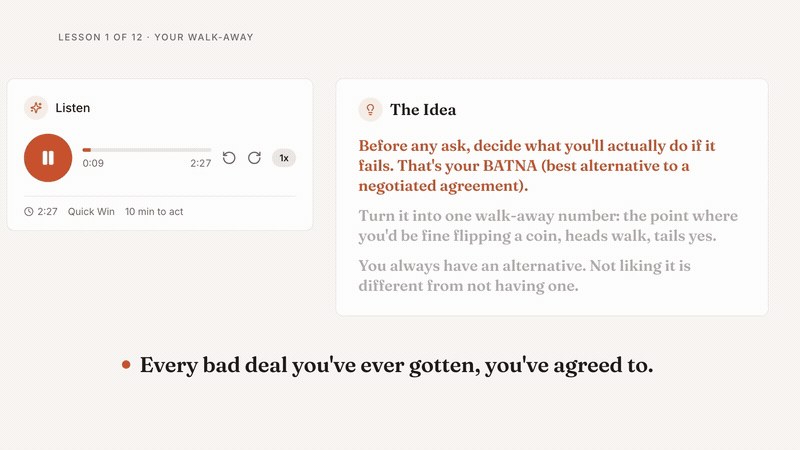
What a lesson looks like
The README uses a real negotiation course as its example. Lesson one is “Your Walk-Away”, 2 minutes 27 seconds of audio, and the card next to it says:
- Core idea: before you open your mouth, decide what you’ll do if they say no.
- Source agreement: how many sources back this claim, and who disagrees.
- Try this: pick a request you’re about to make (a raise, a refund, your rent) and write three lines: “If this falls through, I will…”, “This is worth … to me”, “My walk-away point is…”, with an estimate of how many minutes it takes.
- Keep a rule: every lesson distills one rule, and at the end they’re collected into a “rulebook” you keep.
The design motto is “listen for 2 minutes, try one thing, keep one rule”. Compared with dozens of hours of recorded lectures, this format is a lot easier to actually finish.
How it builds a course
- Break down the topic: it first searches how the subject is usually taught and splits it into 12 to 18 subtopics.
- Gather sources: several rounds of searches per subtopic until it has 20 to 40 pages, preferring practitioners’ experience, official documentation and research reviews, and deliberately including a few contrarian takes. No more than 3 pages from any one site, so a single voice can’t dominate. Content farms, login-walled pages and advertorials are skipped.
- Read and compare: several “reader agents” read pages in parallel and take notes with citations, then one agent merges them into themes and counts how many sources support each claim.
- Sequence the lessons: roughly one unit per 4 lessons, fundamentals first.
- Make one sample lesson first: after lesson one it stops and waits for your feedback. Only once you’re happy does it write the rest and record the audio.
The best part is the citation check: a script rejects any lesson that cites a page that wasn’t actually read during research. The author notes that in the first full test, 12 of the 34 URLs the model suggested didn’t even load, so every link now has to be a page that was really fetched. The biggest risk when learning from AI is confident fabrication, and this design tackles it head-on.
If you’d rather learn from a specific person, say teach me negotiation from <name>'s writing and it’ll find their Substack or blog and build the course only from what they wrote.
Installation
You need to already be using Claude Code with web search available. Claude Code isn’t included in the free Claude plan; you need at least a Pro subscription. New to the Claude Code ecosystem? Our AI coding agent ecosystem overview (in Chinese) maps out the add-ons.
In Claude Code, type:
/plugin marketplace add assafkip/claudemy
/plugin install claudemy@claudemy
Alternatively, copy the repo’s skills/claudemy/ folder into ~/.claude/skills/, or download claudemy.skill from Releases. Once it’s installed, just say teach me <topic>. Where skills live and how plugin marketplaces work is covered in more detail in our roundup of 5 popular AI coding skill packs (in Chinese).
Your computer also needs:
- Python 3 with
beautifulsoup4(pip install beautifulsoup4) for fetching pages; ffmpegfor stitching the audio together;- Optional:
pandoc, if you want a Word version of the lesson cards.
Voices: the one choice that matters most
| Option | Result | Cost | Platforms |
|---|---|---|---|
| ElevenLabs | Two natural conversational voices, using the eleven_v3 model by default | Uses credits from your ElevenLabs plan | All |
Built-in macOS voices (say) |
Listenable, but flat, like reading aloud | Free, offline | Mac only |
| No audio | Cards and rulebook only | Free | All |
Your ElevenLabs key can go in the ELEVENLABS_API_KEY environment variable, or you can enter it in the config prompt when installing the plugin, which stores it in the system keychain.
Windows and Linux users, take note: without an ElevenLabs key, it only knows how to use the macOS say command. We read the audio script: with no key and no Mac, it exits with a “no audio engine” error. Cards and the rulebook are still generated, but there’s nothing to listen to. If you want free local voices, for now you’ll have to modify the script yourself, for example to call a local TTS tool such as VoiceStudio, an open-source ElevenLabs alternative.
Can it make courses in other languages?
The README doesn’t mention other languages, and all the examples are in English. Our read: Claude writes the course content, so if you ask for a course in, say, Spanish or Chinese, getting a script in that language shouldn’t be a problem. The hard parts are voices and sources:
- Voices: ElevenLabs eleven_v3 is multilingual, but the two default voices (Liam and Jessica) are English voices. Swap them with
CLAUDEMY_VOICE_AandCLAUDEMY_VOICE_Bfor voice IDs you’ve picked in ElevenLabs. Mac users can setCLAUDEMY_SAY_AandCLAUDEMY_SAY_Bto system voices in that language (download them in System Settings first). - Sources: it fetches pages with plain HTTP requests and skips anything that needs a login or JavaScript to show the article. In ecosystems where much of the good content sits inside walled apps (as with Chinese platforms like WeChat articles or Xiaohongshu), it will find far fewer usable sources than in English.
That’s our inference from reading the code; the author hasn’t tested non-English courses, so try a single lesson on a small topic first.
Privacy and cost
Claudemy runs on your own computer inside Claude Code. Fetched pages are saved in a ./claudemy/<topic>/ folder in the current directory, for your own study only. If you set an ElevenLabs key, each lesson’s script is sent to ElevenLabs to generate audio. It has no servers of its own and collects no usage data.
The skill itself is free. What costs money is your Claude subscription (building a course runs for a long time and uses a fair amount of quota) and ElevenLabs credits if you want natural voices. The README describes a 12-lesson course as “one long Claude Code session” that ends with about 25 minutes of audio.
Pros and cons
Pros
- Courses are built fresh for your topic and level, not recorded years ago;
- Every claim is labeled with how many sources agree, and it points out where experts disagree;
- The citation check blocks fabricated links;
- Two-minute lessons with one small exercise each make it far more likely you’ll finish;
- Free and open source, so you can adapt it to your needs.
Cons
- Requires Claude Code with web search;
- Natural voices depend on paid ElevenLabs; the free voices are Mac-only;
- Non-English sources and voices aren’t officially supported and need tweaking;
- Building a course takes a lot of time and quota, so it’s not for quick questions;
- For health, legal and finance topics it only adds a “depends on your situation” disclaimer and is no substitute for professional advice.
Who is it for?
- Good fit: Claude subscribers who like listening to podcasts on the commute or at the gym; professionals who want a fast on-ramp to a new field (negotiation, pricing, hiring, SQL); developers who want to borrow its “AI research + citation check” workflow for their own projects.
- Not a great fit: people without Claude Code who don’t plan to subscribe; Windows-only users who don’t want to pay for ElevenLabs; people who mainly want to learn from content that lives behind logins or inside apps.
For another open-source project that puts Claude Code to work on your own tasks, see AI Job Search, a set of commands that tailors your résumé, writes cover letters and preps you for interviews.
Project info
- Latest version: v0.3.2 (October 16, 2026)
- Requirements: Claude Code (with web search) + Python 3 + ffmpeg; free voices on macOS only
- License: MIT, free and open source
- Repo and downloads: assafkip/claudemy | Releases | Privacy notes


