


Want a conference keyword-trend page without standing up a crawler and a database first? paper-trends is a lighter path: type a conference name, pull public paper metadata from free OpenAlex, then generate a clickable report — keyword trends, topic drift, and institution / author / country shares. Repo Minjia-Hu/paper-trends (MIT, about 0★ when checked — brand new), latest v0.1.0 (2026-11-01). Chinese online demos (ECTC, CVPR, …) need no signup: minjia-hu.github.io/paper-trends. Researched November 2, 2026.
At a glance
| Item | Details |
|---|---|
| Type | Conference paper-trend analysis (CLI + static HTML report + Streamlit) |
| Version | v0.1.0 (2026-11-01) |
| License | MIT |
| Stars | About 0 when checked (very new) |
| Data | OpenAlex metadata (CC0 per OpenAlex docs) — not full text |
| Online demos | No signup / no API key to view sample reports; full Explore needs a local install |
| Local reqs | Python 3.12+, uv; full fetches need a free OpenAlex API key |
| Entry | GitHub · Online demos |
What it does — and what it does not
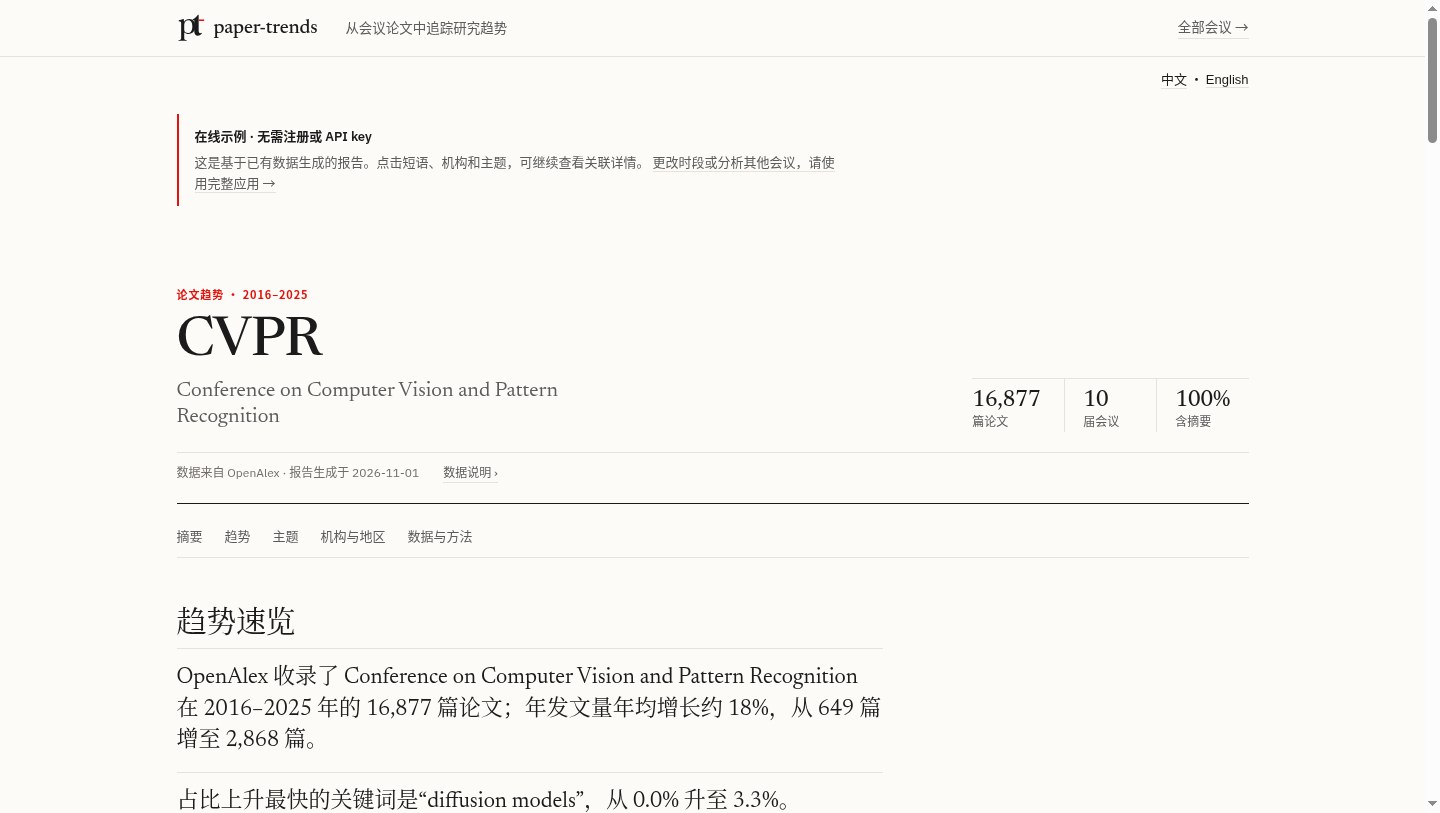
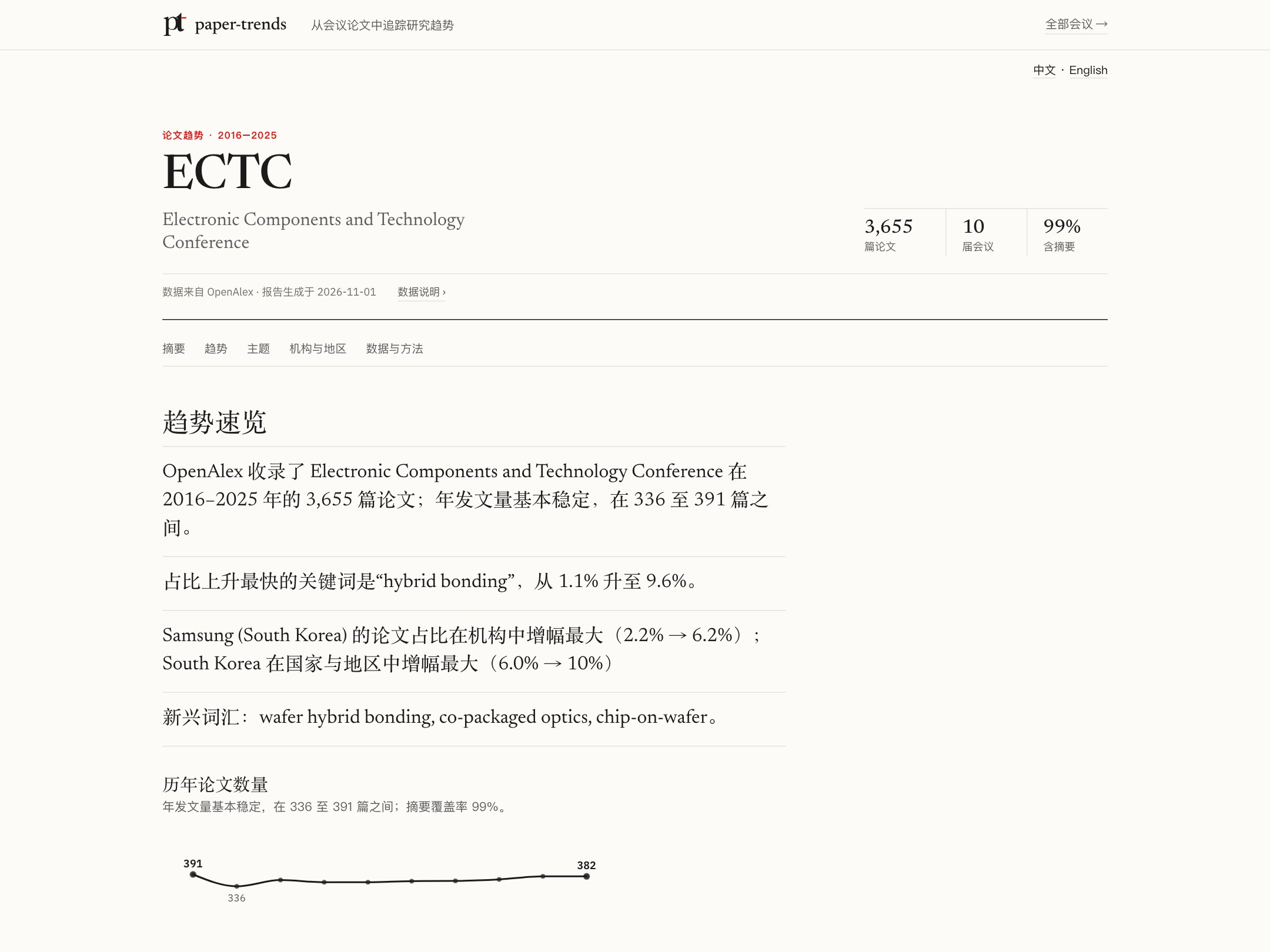
Online demos: open a CVPR / ECTC static page for summary, trends, topics, institutions and regions. Phrases, institution rows and themes drill into detail. The page labels itself “online demo · no registration or API key”. The CVPR 2016–2025 sample shows roughly 16k papers across 10 editions, with call-outs for diffusion models and shifting institution/country shares (as of the page’s generation date).
Full local stack: resolve finds the venue → fetch pulls metadata → report writes static HTML, or streamlit run app.py for Report / Explore. Explore lets you tweak time windows and counting rules, open supporting papers, export CSV, and compare phrases across conferences.
Hard boundaries: stats come from phrase matches in titles and abstracts — this is not a full-text reader or library. OpenAlex is sparse for no-DOI / delayed-abstract years; same-name institutions can mis-map; newest-year abstracts may lag by months. Full cursor-paged fetches need an OpenAlex API key from page two onward; anonymous requests also share a quota with the same IP. The project is early — commands and UI will move; trust the repo README / Changelog.
How it sits next to tools on this site
| Need | Better fit |
|---|---|
| Turn a Zotero PDF into link-back Markdown | Mktero |
| Keep layout while bilingual-translating work PDFs in ChatGPT | Babeldoc4GPT (EN pending) |
| Quiet open-source desktop PDF reading | Folio |
| Scan a conference’s recent hotspots / institution map | paper-trends |
It helps you “feel the room”: which phrases are rising, who publishes, how topics drift. Close reading of one paper still belongs on a PDF toolchain.
Who it is for (and caveats)
Good fit: students / researchers scouting a venue before a lit review; people who want a keyword and institution map before writing a survey; anyone willing to install Python locally for their own conference list.
Caveats: do not treat it as Sci-Hub or full-text search; demo pages are pre-generated snapshots — swap venues via the local path; when OpenAlex coverage is thin, conclusions only cover what is indexed. Version and demos follow the November 2, 2026 README / live pages.
Entry: Source & CLI · Chinese online demos.


